

Leadership isn’t just about tasks; it’s about people.
A student leader with high Emotional Intelligence can read the room, understand their own reactions, and respond to others with empathy.
Teaching Emotional Intelligence begins with establishing a shared language in the classroom for how we feel and how we interact.
When students grasp their own emotions, they become much better at managing themselves—and significantly more effective at leading others.
Here are five simple ways to integrate Emotional Intelligence into your daily classroom routine.
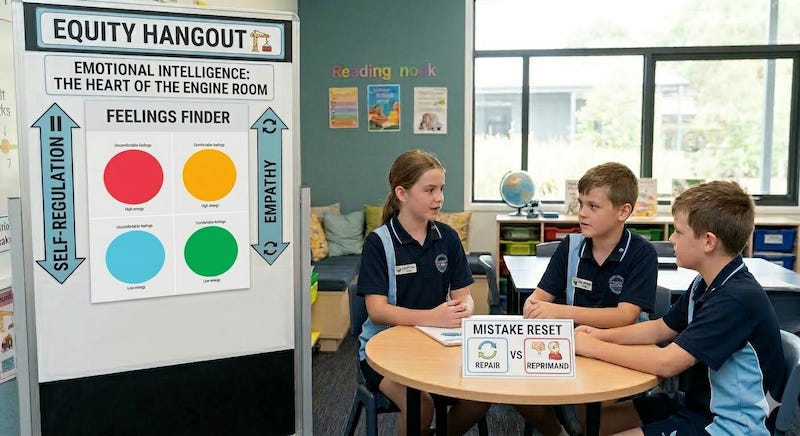
1. Use the Feelings Finder to check in.
It is a basic truth of leadership and teaching that you cannot manage what you haven’t first identified.
When a classroom feels chaotic or sluggish, our instinct is often to override the mood with authority or entertainment.
However, if you want to build true capability in our students, you need to shift the focus from us managing their behaviour to them identifying their own internal states.
The most effective way to do this is to teach students to take a quick feelings check. This isn’t about deep therapy; it is about providing a simple language for self-awareness.
Ask students to identify if they are currently:
Red (High Energy / Uncomfortable): Feeling agitated, frustrated, or overwhelmed.
Blue (Low Energy / Uncomfortable): Feeling tired, sad, or disinterested.
Green (Low Energy / Comfortable): Feeling calm, relaxed, and receptive.
Orange (High Energy / Comfortable): Feeling excited, motivated, and ready to move.
This simple habit teaches more than just vocabulary. When a student can say, I’m in the red today, they are taking the first step toward self-regulation before a conflict even starts. It allows them to recognise their own internal weather and adjust accordingly.
2. Teach kids how to say nothing at all
In the heat of a group project, the difference between a leader and a bystander is often found in what is not said.
We frequently focus on teaching students how to speak up, but the more sophisticated leadership skill is knowing when to pause.
True influence is built on the muscle of self-control. When a student can move from being a reactive participant to a deliberate leader, they change the entire dynamic of the room.
The Science behind the 90-Second Rule
To help students master their reactions, we need to teach them the biology of their emotions. A physical wave of emotion—the chemical surge of adrenaline or cortisol—actually only lasts about 90 seconds in the body.
When a student feels a flash of anger because a peer isn’t pulling their weight, or frustration because an idea was rejected, that “heat” is a temporary physiological event. The problem isn’t the 90-second wave; it’s the “story” we tell ourselves afterward that keeps the wave crashing for hours.
Implementing the 90-Second Pause
If a group project gets heated, encourage your students to call a 90-second pause before anyone responds to a provocation. This isn’t a “time-out” in the traditional sense; it is a strategic leadership tool.
During those 90 seconds, encourage students to:
Identify the sensation: Recognise the “Red” energy without acting on it.
Breathe through the surge: Let the chemical spike dissipate naturally.
Choose the response: Move from the emotional brain back into the logical, “Green” zone where problem-solving happens.
This practice stops reactive leadership in its tracks. A student who can wait out their own internal storm is far more likely to practice high-level Emotional Intelligence and Teamwork. They learn that they don’t have to be slaves to their first impulse.
By mastering the pause, students develop the internal durability required to lead others through high-pressure situations. They realise that while they cannot always control the “heat” of the moment, they have total control over their own temperature.
3. Show kids how to pivot their perspective - a powerful tool if ever there was one
Conflict between students is the true test of emotional intelligence.
In the heat of a disagreement, most students simply react—they’ll fight, take flight, or freeze.
These are primal responses, not leadership ones.
When we only step in to referee the fight, we miss a vital opportunity to build their internal durability and social competence.
To move beyond the cycle of blame, we must teach students to take a different tack.
Moving Beyond the Primal Reaction
When a conflict arises, your goal is to move students from their reactive brain to their thinking brain.
This requires a sophisticated skill known as the Perspective Pivot.
The Perspective Pivot is the foundation of empathy, but it is also a high-level practical tool for teamwork. It moves a student from a position of “I’m right” to a position of “I understand why you’re upset.” This is the only place where real, lasting solutions are found.
How to Facilitate the Perspective Pivot
Instead of asking “What happened?” (which usually leads to a list of grievances), try this three-step approach:
The Cooling-Off Period: Use the 90-second rule to let the initial chemical surge of the “Red” zone dissipate. You cannot pivot your perspective while your brain is in survival mode.
The Role Reversal: Ask each student to describe the situation specifically from the other person’s point of view. They must use “I” statements as if they were their peer. For example: “I felt frustrated because I thought I was doing all the work on the poster.”
The Validation Step: Once the other person’s view has been voiced, the focus shifts to finding common ground. The question becomes: “Now that we both see the two different sides, what is our plan to move forward?”
The Perspective Pivot is one of the hardest leadership skills to master because it requires a student to temporarily set aside their own ego.
However, a student who can see the world through another person’s eyes is well on their way to mastering Emotional Intelligence and Teamwork.
By encouraging this pivot, you aren’t just settling a playground dispute; you are equipping them to lead diverse groups for the rest of their lives.
4. Recognise the quiet contributor
Great leadership is often about what you notice, not just what you say.
By default, most of us—adults and students alike—tend to focus on the most vocal people in the room.
However, true influence is found in the ability to see the entire group, not just the loudest members.
To build genuine social awareness, set a specific challenge for your student leaders: find the invisible student.
Your Inclusion Challenge
In any group project or team activity, task your leaders with identifying the person who hasn’t shared an idea or looks a bit overwhelmed. Their job isn’t to take over, but to actively bring that person into the conversation.
This simple shift in focus moves a student leader from “managing a task” to “managing a team.” It reinforces several key building blocks:
Teamwork: Realising that a project is only as strong as its quietest contributor.
Emotional Intelligence: Developing the “radar” to read the room and sense when someone is retreating.
Responsibility: Understanding that a leader’s primary duty is to ensure the whole team is functioning, not just the high-energy participants.
When a student learns to look for the person on the margins, they are practising a sophisticated form of leadership. They are learning that their role is to create a space where everyone belongs.
By championing the quiet voices, they aren’t just finishing a task—they are building a stronger, more capable community.
5. Model The Mistake Reset
How a student leader handles a blunder defines the entire team’s culture. If the atmosphere is one of blame, students will hide their errors. But if the focus is on growth, they develop the internal durability to move forward.
The key is to move from a reactive mindset to a reset mindset.
Yes, your students are watching!
Students watch how you respond when a lesson plan goes off the rails or a technology glitch occurs.
When things go wrong, demonstrate a calm reset rather than an emotional reaction.
This models the high-level Emotional Intelligence required to lead under pressure.
Focus on Repair, Not Reprimand
When a student makes a mistake that impacts the group, shift the conversation immediately to the solution.
Instead of focusing on the “why” of the failure, focus on the “how” of the fix.
Ask one simple question: “How can we make this right?”
This approach reinforces the most vital building blocks of leadership:
Responsibility: It shifts the focus from guilt to action.
Teamwork: It prioritises group harmony over personal ego.
Organisation: It encourages a practical plan to get back on track.
True leadership isn’t about being perfect; it’s about being responsible for your impact on others.
When you prioritise repair over reprimand, you teach students that mistakes are simply data points on the road to capability.
Why Emotional Intelligence matters
Developing Emotional Intelligence is the ultimate “work smarter, not harder” strategy for teachers.
When students can manage their own emotions and empathise with others, classroom management becomes a shared responsibility rather than a solo burden.
By focusing on these five areas, you are doing the vital work of building a compassionate, self-regulating community.
It’s not an extra task; it’s the foundation that makes everything else in your classroom possible.

Ready to Build Real Student Leaders?
True leadership isn’t just a title—it’s a mindset. The Young Leaders Program resources give you the toolkit to turn student potential into everyday action.
Built on the Young Leaders’ five building blocks of leadership, these ready-to-use resources foster real accountability, teamwork, and student agency without adding hours to your planning.
Don’t just assign leadership roles—teach them how to lead.
This post offers great ideas for teaching Emotional Intelligence in the classroom. It focuses on helping students recognize their emotions, practice empathy, and become better leaders. The five tips—from checking in with a “Feelings Finder” to learning how to bounce back from mistakes—create a supportive and respectful classroom environment. I love how these habits encourage students to take care of themselves and each other while growing as leaders.