

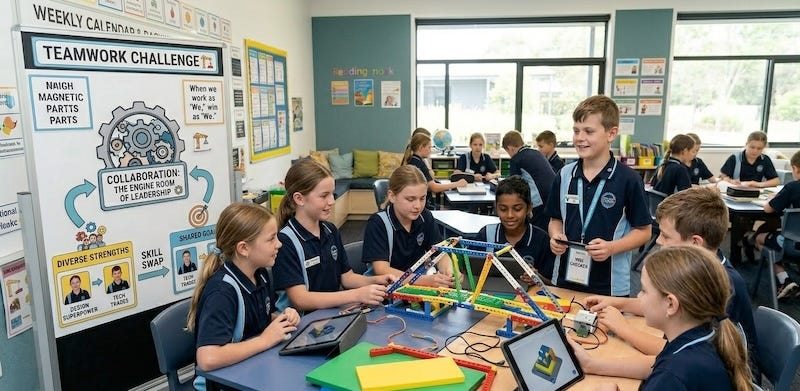
I often heard talk about teamwork as if it’s just about being “a nice to do” or “getting along.”
But teamwork is a high-level leadership skill.
It’s the engine room of collaboration—the ability to coordinate different strengths to reach a common goal.
What teamwork means for students
It is the fundamental shift from a student thinking about their own success to being genuinely invested in the success of the person sitting next to them.
As a teacher, fostering teamwork doesn’t have to mean more noise or added chaos in the classroom.
It’s about creating the structures that allow students to work together without needing you to referee.
When you teach kids how to truly collaborate, you aren’t just ticking a box; you’re giving them the social and emotional tools they’ll need for a self-governing life.
There are many ways you can harness your students’ ability to work together without adding another burden to your day.
Here are five simple ways to get started.
1. Use the skill swap strategy
Every student has a strength—some are great at drawing, others are quick with numbers, and some are natural storytellers.
Before a group task, have students identify one thing they are good at and one thing they might need help with.
Pair them up so they can trade expertise.
This teaches them that leadership isn’t about knowing everything; it’s about recognising and appreciating the diverse strengths of a team.
2. Challenge students to work together silently
It’s annoying!
When the loudest voices in a group drown out the best ideas, that is.
To build true awareness, set a 5-minute challenge in which a group must complete a simple task—such as building a structure or organising a set of cards—without speaking a single word.
The upside?
Students learn to watch each other’s movements, anticipate needs, and communicate through cooperation rather than just talking.
It highlights the silent side of great teamwork.
3. Appoint a vibe checker
In any team, emotions can run high, and a great leader knows how to read the room.
Teaching kids to pick up the emotional temperature of others is giving them a valuable gift that can last a lifetime.
I’ve found that this idea works really well.
During group work, rotate the role of a Vibe Checker.
Their job isn’t to do the heavy lifting, but to ensure everyone is being heard and that the group’s temperature stays positive.
This builds high-level emotional intelligence and teaches them that how we work together is just as important as the work we produce.
4. Discuss team success
Here’s a question to ponder.
Are you conditioned to praise individual achievement and ignore collective success?
It’s an important question as leadership thrives on collective success.
Try this activity to foster a sense of teamwork.
At the end of a project, shift the focus by asking: “What did your teammate do that helped the group succeed?”
This simple shift in questioning trains students to look for the best in others and reinforces the idea that in a strong team, one person’s success is a win for everyone.
5. Test teamwork with a curveball
All teams are tested when things go wrong.
Halfway through a task, throw in a small curveball—change a rule or shorten the time by two minutes.
Instead of stepping in to fix it, let the group huddle to decide on a new plan.
What happens next will test the team's mettle. A good team will pull together, not fall apart. If the latter occurs, then some teacher-led reflection should follow.
This activity builds adaptability and teaches them that the team is their best resource when things get tough.
It turns a potential frustration into a collective problem-solving moment.
Why teamwork matters
Teamwork is the glue that holds all other leadership building blocks together.
When a student learns to collaborate, they stop seeing their peers as competition and start seeing them as partners.
By building these habits in your classroom, you are creating a culture of support and capability.
You’re proving to them that they can achieve far more together than they ever could alone, and that is a lesson that stays with them long after they leave your school.
Update: Only 14 Days Remaining

Ready to Build Real Student Leaders?
True leadership isn’t just a title—it’s a mindset. The Young Leaders Program resources give you the exact toolkit to transform student potential into everyday action.
Built on the Young Leaders’ five building blocks of leadership, these ready-to-use resources foster real accountability, teamwork, and student agency without adding hours to your planning.
Don’t just assign leadership roles—teach them how to lead.